
I visited my grandfather in Warrensburg, one day, many years ago. We looked at an ancient photo album. At the turn of the last century, his parents were caretakers at an Adirondack great camp.
While he couldn’t remember the name of the camp, he recalled a floating, screened gazebo, complete with grand piano.
The lady of the house used it to escape black flies, floating into the middle of the lake. Camp workers would tow her back in to shore, in the evening.
Thanks to some old timers working at McCauley Mountain, I learned a few years later that the floating gazebo was part of Camp Pine Knot, the first ever Adirondack great camp, on Raquette Lake. For 20 years, I’ve wanted to visit, and I finally did this week.

Camp Pine Knot was originally conceived by Thomas Durant — a railroad tycoon who built the eastern half of the Transcontinental Railroad — in 1877. The completion of the railroad in 1869 led to massive accumulation of wealth for those involved.
Envisioning real estate development, Thomas Durant spent his new money in the Adirondacks, snapping up half a million acres of land for $.05 per acre. He built a rail line from Saratoga Springs to North Creek to get people there. Prior to the rail line, the horse and wagon journey north could take weeks. At the same time Americans became interested in getting back to nature.

In 1879, Durant turned over to his son, William, responsibility for managing and developing Pine Knot. The younger Durant’s vision was a compound of buildings that blended in with the environment.
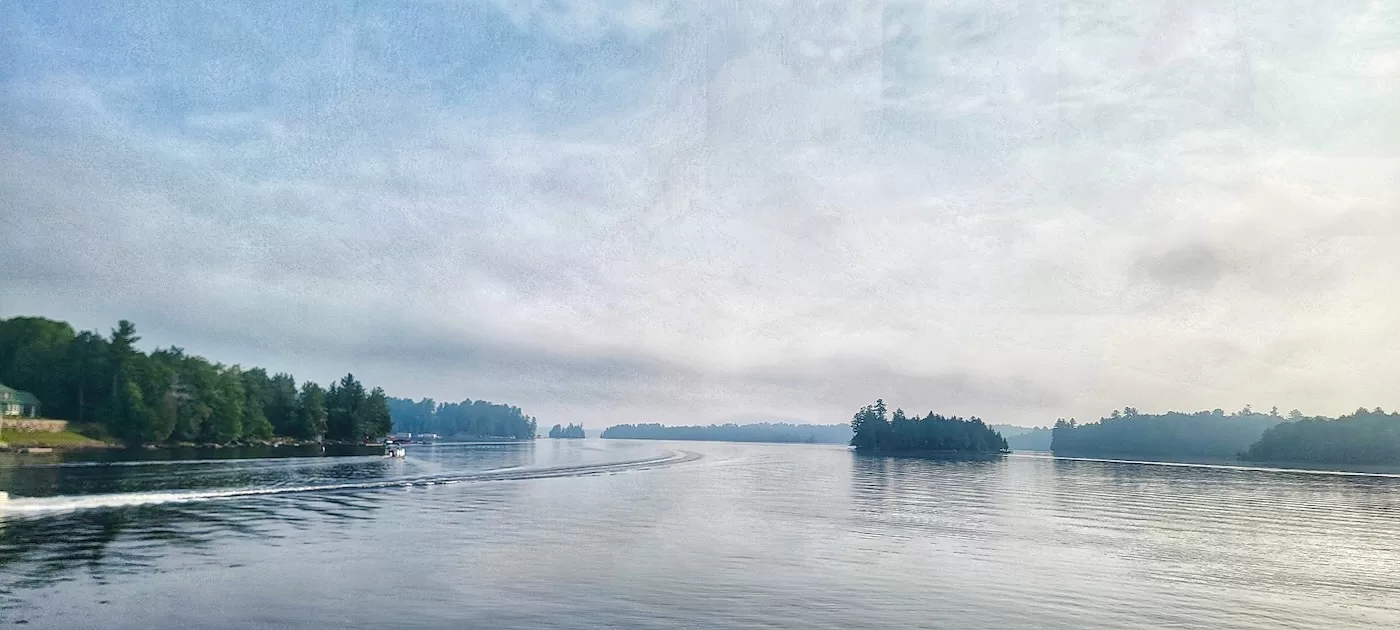
Last Tuesday, I drove to Raquette Lake. The hamlet is little more than a marina, a general store, and a couple of churches. It’s a far cry from Old Forge, where I stayed the night before. Old Forge (and Long Lake, and Inlet) rocked like the Jersey shore. With several dozen other curious souls, I boarded the Raquette Lake Navigation Company’s excursion boat for the trip to Camp Pine Knot. The sky was hazy with wildfire smoke as we cruised to the old camp.

The property is owned and maintained by SUNY Cortland, who use it for educational purposes. Like the vast majority of other properties on Raquette Lake, Camp Pine Knot is only accessible by boat. When we debarked, a knowledgeable SUNY guide was there to show us around.
When Durant conceptualized Camp Pine Knot, each building had a single purpose. The camp had to blend in with the landscape. Thus, local materials were the order of the day: bark siding, twig work. One slept in a sleeping cabin; one dined a dining cabin.

Of course, the kitchen was a separate building from the dining area. Durant’s original entertaining cabin was a single story. Later, he felt it necessary to raise the roof to provide more room for his guests. Camp staff and servants had separate quarters, comfortable but of more utilitarian design, from the Durants.
Durant’s Gilded Age guests were smitten with his camp and the lake. Many of them were inspired to build great camps of their own. Durant was only too happy to sell them a chunk of land and develop their property. Robber barons snapped up acreage on Raquette Lake, and Durant built their compounds after the style of Camp Pine Knot. Like the original camp, they were only accessible by boat.

This vintage NY Times clipping gives one an idea of Raquette Lake’s popularity was with the monied class of the time.
During the tour, I asked about the floating gazebo in my grandfather’s scrapbook, but it’s gone. And when the guide asked my great grandparents’ name and said she wasn’t aware of it, I got annoyed. But I kept my mouth shut.
While the gazebo is history, a houseboat, restored by SUNY, remains. It’s laid out like a shotgun shack, and didn’t have power of its own. Camp workers would tow it out to the middle of the lake.

Because of the camp’s remote location, Durant and other great camp owners strived for self-sufficiency. Pine Knot was big enough to accommodate a working farm and livestock.
Durant built a second great camp, Camp Uncas, for himself in 1890. Completed in two years, it was also built from native materials. In 1896, he sold it to J.P. Morgan.

By all accounts, the younger Durant had a penchant for spending money faster than his father had earned it. He kept adding on to the property. And it seemed like he frittered away the fortune his father had built. To settle a debt, he turned Camp Pine Knot over to another railroad magnate, Collis Huntington, in 1895.
Huntington built the “living room” below because Durant’s original Swiss chalet wasn’t big enough to accommodate all his guests. SUNY Cortland put metal roofs on most of the buildings as the original roofs had fallen into disrepair.

After selling Pine Knot and Camp Uncas, Durant bought property on Shedd Lake, south of Raquette Lake. Undaunted by his massive debts, he built what he considered his pinnacle, Camp Sagamore. Like Pine Knot and Uncas, it was a compound of buildings built using native materials.
The combination of Durant’s lavish lifestyle and the boom and bust nature of his finances was compounded by a lawsuit by his sister that disputed his handling of the family estate. Divorce added to Durant’s financial troubles. In 1901, Durant sold Camp Sagamore to Alfred Gwynne Vanderbilt. In 1904, he declared bankruptcy.

After Collis Huntington died in 1900, Camp Pine Knot lay vacant for over 40 years. The sole resident was a caretaker whose primary job was to chase off trespassers rather than maintain the extensive property. In 1947, Huntington’s heirs gifted it to SUNY Cortland for one dollar.
I enjoyed seeing how the other half lived during the Gilded Age. I wondered: would modern business tycoons would look down their nose at a classic great camp compound, or embrace it?

The only way to visit is to book a trip with the Raquette River Navigation Company. The fare wasn’t cheap, but it was definitely worth it. The boat leaves at 8:30 AM, so I’d recommend staying locally. For me, coming from Saranac Lake, it was near a two hour drive.
Yep, definitely a really cool spot.
I’ve been there many a time w/ friends from SUNY Cortland
Thanks for sharing!
Very interesting!
Thanks! Great history! Great photos!
Interesting history updating to the present. Think I canoed past it while paddling the Adirondack 90 forty years ago.
Good to see that the camp has been preserved. Someone must have information about the floating gazebo. How long was the tour? Were you allowed to walk the grounds freely?
Great history lesson!!! Thanks for your research!
@ Mark. We were on the property for a little more than two hours. We did not walk around freely. About half the people on the boat (dare I say “boat people?”) were shown around by the guide from SUNY Cortland. Our guide was most knowledgeable; I wouldn’t have gotten as much out of the trip without a guide. In addition, SUNY uses the property for multiple outdoor education projects and some of the buildings are occupied by students. In the photo of the trappers cabin above, you may notice [modern] paddling gear on the porch from the person staying there..
The other half were staying at Great Camp Sagamore and had their own guide. After William Durant declared bankruptcy, Great Camp Sagamore changed hands several times. It came within a hairsbreadth of being demolished under “Forever Wild” laws before being res cued and restored by preservationists. It really merits a story of its own.
Peter. Thank you for the information. I look forward to visiting sometime.
Peter – Thanks for the great history – very interesting. This sounds like a great place to visit sometime. Also of note to NY skiers is the background of the names of a few trails at Gore Mtn. Excellent post. Thanks.
Good stuff, Peter. That looks like a cool place and the history is interesting.
Awesome report Peter and the pictures are fantastic.
While I was with SUNY I had the opportunity to stay at Camp Pine Knot for a special conference.
You are quite right each building in the compound represents a different room in a household.
While we were there so then director George Fuge regaled us with stories of Durant’s time nightly in the building you called the living room which we used to call the “Student Union.”
Apparently the younger Durant was something of a character and would often tire of his guests and be bored out of his skull he would then retreat to the barge in the middle of the lake to get some peace and quiet.
While there we were housed in some buildings on one of the back bays of the peninsula I think it’s where they used to house the students who were there in residence for a semester.
That’s another story apparently in the winter time during this winter semester they would build an ice road to go from the mainland to Pine Knot.
Glad you had the opportunity to explore Pine knot and learn of it’s interesting history.
SUNY Cortland owned a lodge on the mainland from which we boated to Pine Knot. Back in the 30sand 40’s it was called the Antlers Resort.
My dad worked there as a college kid during the Summers.
His mother and father owned a camp on Otter Lake just south of Old Forge where we spent many a weekend in the summer and grew to love the area.
Peter,
Thanks for the report and the pictures especially. Durant really shaped the history of the area! I love the lake and was boating there just last week. Until very recently my sister had a smaller (much smaller) camp on Sucker Bay, so we ran past Pine Knot and several other camps coming and going by boat. We also visited by bicycle from Raquette Village and by snowmobile and skis in Winter. There’s a great walk or ride to Tioga Point from the Buttermilk Falls road too.